
Thailand EV policy counted cars built locally, not parts. BYD makes 75% of its own components, so Thai suppliers lost. Why the new tax rewrites it.
Thailand wrote its EV rules in cars built. The jobs it wanted to protect sit in the parts, and its new automakers make most of their own.
Chinese brands went from almost nothing to about 85% of Thailand’s electric vehicle market in four years, and the country’s 700,000-worker auto parts chain is absorbing the cost. The usual explanation is that Thailand opened the door too wide. The sharper one is that it priced the entry ticket in the wrong unit: its incentive rules counted locally assembled cars, and BYD, the market leader, makes roughly 75% of its own components.
The cautionary-tale version of this story writes itself. Thailand handed out subsidies and tax cuts, Chinese carmakers flooded in, Japanese plants closed, and Thai suppliers went bankrupt. The New York Times laid it out on October 16, and the government’s own chief economic planner admitted the shift came far faster than Bangkok expected.
But the same country used the same basic tool once before and got the opposite result. Thailand became the “Detroit of the East” by luring Japanese automakers with local production requirements. Those requirements built a supplier base because of how Japanese carmakers buy parts, not because of the rule itself.
That difference, between an automaker that buys its parts and one that makes them, is the whole story. It also explains why Thailand’s new three-tier tax is the first policy aimed at the thing the country actually wanted.
The scene in Rayong province is the industry’s new map in miniature. BYD built its first factory outside China there, a complex the Times sizes at 180 football fields. A former General Motors plant nearby now belongs to Great Wall Motor. Ford took over a Suzuki assembly plant down the road. All of it happened inside five years.
The share numbers moved even faster. Chinese automakers now hold about 85% of Thailand’s EV market, up from near zero four years ago. Battery electric vehicles took 30.88% of domestic car sales from January to July 2026, according to the Federation of Thai Industries. And roughly two-thirds of the EVs sold in that window were imported, mostly from China, two years after BYD’s local plant opened.
On the other side of the ledger:
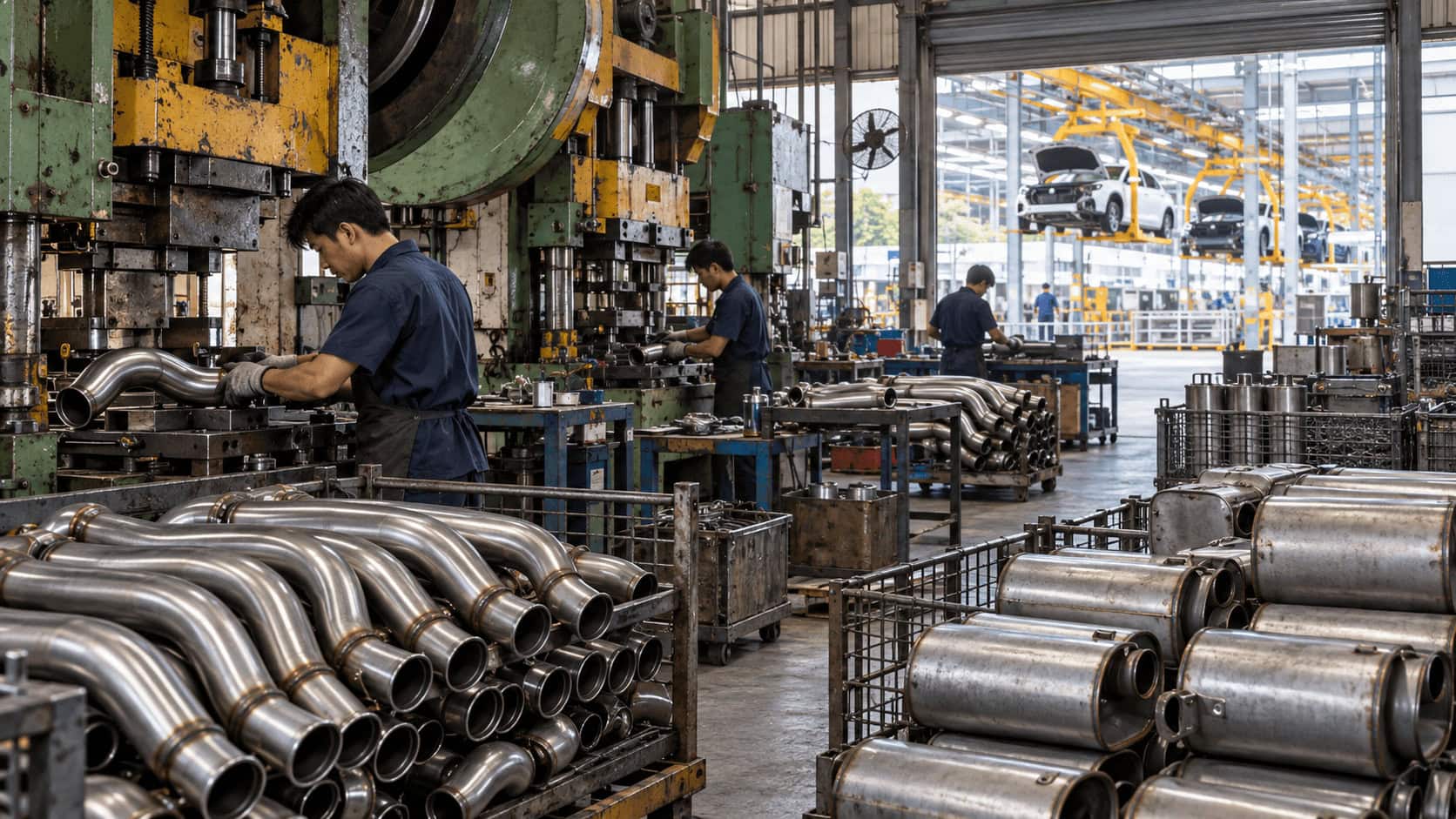
The Times anchors that last number with one worker. Netsana Sakulpolpanya spent 13 years at a Samut Prakan parts factory making exhaust systems and mufflers, with Toyota as the biggest customer. She earned $440 a month. Her employer went bankrupt in 2024, nearly 900 workers lost their jobs without severance, and she now earns $11 a day at a supermarket.
Bangkok is now reversing course. On September 10, the national EV policy board agreed in principle to a three-tier excise tax that charges the least for cars built with deep local content and the most for fully imported ones. Prime Minister Anutin Charnvirakul flew to Tokyo last month to reassure Japanese automakers.
Thailand’s EV 3.0 program launched in 2022 with a straightforward trade. Automakers got purchase subsidies, an excise cut from 8% to 2%, and import duty relief, on top of the zero customs duty Chinese vehicles already enjoyed under the ASEAN-China free trade agreement. In return they promised to build locally later.
The promise was denominated in cars. For every EV imported under the scheme, a maker had to build one in Thailand in 2024, rising to 1.5 in 2025. The follow-up package, EV 3.5, raised the ratio to two local cars per import in 2026 and three in 2027, with the Excise Department budgeting about THB 34 billion for it. In late 2025 the government added a sweetener: every Thai-built EV that gets exported counts as 1.5 cars toward the quota.
There were local content rules too, but they were light. BEVs needed 40% local or ASEAN content to qualify for some incentives, and the battery requirement could be met by assembling packs in Thailand from imported cells. The Times saw battery cells arriving from China at BYD’s plant.
So the binding constraint was a headcount of finished vehicles. And automakers optimized for exactly that:
Meanwhile, the imported cars set the price. In 2024, BYD’s distributor cut as much as 340,000 baht off an Atto 3 that listed at 1,199,900 baht, a 28% drop that triggered a consumer-protection probe and some furious early buyers. Cheap imports were not a side effect of the policy. They were the policy working as designed, just on the wrong variable. BMA traced the same import-first pattern globally in how China exported its EV glut rather than its way out of it.
The new three-tier excise is Bangkok’s attempt to change the unit. Free trade obligations mean Thailand cannot simply raise tariffs on Chinese cars, Finance Minister Ekniti Nitithanprapas has said, which leaves the excise tax as the main lever. The structure under discussion:
The more important change is buried in the fine print. The local content formula is being rewritten to exclude operating expenses, labor costs and profits, and to weight engines, motors, drive systems and Thai research and development more heavily. That is the first time the rulebook measures what goes into the car rather than whether the car was bolted together in Thailand.
Industry wants it tougher still. Ten automotive and parts associations, including the Thai Auto-Parts Manufacturers Association, have asked for an excise of at least 32% on fully imported EVs, a cap on imports equal to 10% of local production, and an 80% local content requirement. The FTI has floated a 32% to 50% range for imports.
BYD says it is ready. Its Thailand general manager, Benson Ke, welcomed higher taxes on imports, a reasonable position for a company that has put more than $1 billion into Rayong. BYD told Gasgoo in July that local parts sourcing at the plant has reached 50%.
Two numbers from BYD’s own disclosures show what the old rules produced.




0 Comentário(s)
Deixe seu comentário